Which of the Following Is True About Enzymes
They are made of amino acids. Find step-by-step Chemistry solutions and your answer to the following textbook question.

5hto1xhqtb 4qm
The activation energy barrier in case of transition state is far less as.

. Enzymes are very specific for certain substrates. During the progress of a reaction the substrates are separated from products by an energy barrier which the substrates need to cross. Which of the following statements about enzymes or their function is true.
C enzyme activities can often be regulated. Which of the following is true regarding enzymes Enzymes are not very. Which of the following statements about enzymes are true.
Enzymes lower the activation energy of a reaction. Which of the following is NOT true about enzymes. Enzymes are not consumed in reactions they catalyze ie.
Enzymes function best at an optimum temperature 20-40C. Each enzyme has specialized sites that only fit certain substrates. 1 Enzymes are non-specific for a reaction and substrate.
According to the most widely accepted theory enzymes bind to the substrate molecule and form a transition state. E enzymes operate under a wide range of temperatures and pH. It is a catalyst.
Enzymes are proteins which are made up of amino acids. Each enzyme can form many products from a specific set of substrates. D Enzymes catalyze specific reactions.
Each enzyme is designed to work with substrates from all metabolic reactions. This energy barrier is called as the activation energy. 2 Almost all enzymes are proteins.
After the reaction they are not altered or consumed fully. They increase the rate at which chemical reactions occur within the cell. Enzymes are water soluble colloidal macromolecules which are wholly or partially proteinaceous in nature.
Enzymes increase the number of collisions in a chemical reaction. An enzymes function depends on its three-dimensional shape. The enzyme activity decreases with slight decrease or increase from the optimum temperature range.
C Enzymes are the reactants in a chemical reaction. B An enzymes function is unaffected by changes in pH. Enzymes increase the number of.
E All enzymes depend on protein cofactors to function. Which of the following is not true for the specificity of enzyme action. Enzymes are not used up in a reaction.
At very high temperature enzyme activity decreases because denaturation of proteins occurs and enzyme becomes inactive. DEnzymes emerge unchanged from the reactions they catalyze. Each one is specific to a particular substrate to which it binds.
86 7 ratings for this solution. Hence statement D is correct. A Enzymes are inorganic.
BNone of the others. The enzymes are the biomolecules which catalyze the reaction without changing its chemical structure. During chemical reactions Substrates never bind active sites.
Enzymes increase the rate of chemical reaction by lowering activation energy barriers. Enzyme binds a substrate to form an. Enzyme function is reduced if the three-dimensional structure or conformation of an enzyme is altered.
The rate of reaction is enhanced in the presence of the enzyme and the rate id. Enzyme function is influenced by physical and chemical environmental factors such as pHand temperature. Enzymes are made up of proteins.
C Enzyme function is independent of physical and chemical environmental factors such as pH and temperature. Enzymes speed up reactions by lowering activation energy All of these Enzymes do not alter the overall change in free energy for a reaction Enzymes are proteins whose three-dimensional form is key to their function. They are consumed by the reactions they catalyze.
Step 1 of 4. A Specificity refers to discrimination of an enzyme between two competing substrates b Specificity of enzymes lies both the reaction they catalyze and the substrates on which they act c Specificity makes it possible for a number of enzymes to coexist in the cell without interfering in each other. B enzymes catalyze reactions in only one direction.
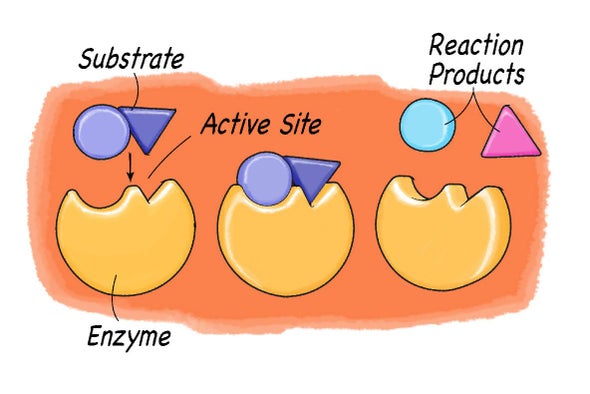
An enzyme can act as a catalyst of the same chemical reaction multiple times. The answer is. C Substrates attach to an enzyme at the active site and will either be broken down or joined together.
D enzymes reaction rates are generally slower than other chemical catalysts. B Salivary amylase is an enzyme that breaks down fats in the foods you eat. Enzymes lower the activation energy of a reaction.
A Nonprotein cofactors alter the substrate specificity of enzymes. Aan enzyme yields a specific product whereas a non-biological catalyst may produce more than one product and side reactions may occur. Enzymes are used up when they catalyze a chemical reaction so must be synthesized for each new chemical reaction.
A specific temperature D. Enzymes are not affected by high heat. B Enzyme function is increased if the 3-D structure or conformation of an enzyme is altered.
Enzymes are used up. A enzymes show very little specificity for their substrates. Select all that apply.
They are the biocatalysts which increase the rate of a chemical reaction by lowering the activation energy of the reaction without being utilized in the reaction. 3 Enzymes work as catalysts by lowering. It is a protein.
They lower the activation energy of chemical reactions. Each enzyme has many sites to fit all. Enzymes speed up reactions by lowering activation energy.
11 Which of the following is true of enzymes. Enzymes themselves change during each reaction and thus can only be used by the body a single time. Enzymes are proteins and they act as catalysts in a cell.
D Enzymes are non-specific making them versatile to participate in any type of. They are highly specific in nature and each enzyme can bind a specific substrate. All of the above are true of enzymes.
Enzymes are not part of the products of a chemical reaction. Enzymes are used up when they catalyze a chemical reaction so must be. The activation energy of the reaction is lowered in the presence of the catalyst.
Breactions occur at the active sight which usually consist of a crevice on. 22 Which one of the following is true. Which of the following statements is true about enzymes and substrates.
Exploring Enzymes Scientific American
Chapter 7 Flashcards Quizlet

Fyzhhpdcdbvtwm


Comments
Post a Comment