Prime Zoom Wide and Telephoto Are All Words That Describe
It has a maximum aperture range of f5-63 meaning that as the lens is zoomed in the widest possible aperture will decrease in size. Answer 1 of 2.

What Does The Mm Mean On A Lens Digital Photo Secrets
The Advantages of Primes.
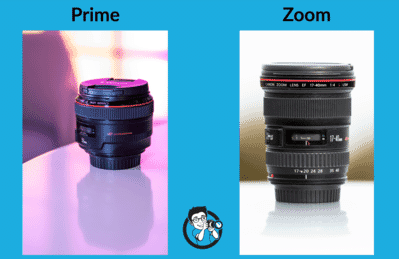
. A zoom lens on the other hand has an adjustable focal length. All simple lenses are fixed focal length also known as prime lenses. They are big heavy and expensive A minimum of 1000 often 2000.
Some lenses even cover both and zoom all the way from Wide Angle to Telephoto. Here are the three categories of telephoto lenses. First the quality will not suffer and often it will be higher than with a zoom.
Design Style Wide-Angle Lens vs. Telephoto lenses range from short all the way up to super-telephoto. 18-70 should cover the most common range from wide to a medium tele and the 50mm gives you a fast short tele.
Many modern prime lenses are significantly cheaper than their zoom counterparts. Zoom lenses tend to be less sharp than prime lenses although professional zooms are still very sharp. For instance a 28-200 millimeter lens lets you take both wide-angle shots and close-ups of distant objects.
Fixed Wide angle 28mm Zoom Wide Angle 12-24mm. This might sound like a shallow consideration in choosing the right gear but there are two arguments I could say in defence of it. An extra-wide angle telephoto may be 14-24mm.
At any focal length under 50mm the lens starts to take extra light in from the sides bringing more of the surroundings into the frame. With fast primes that have maximum apertures like f14 or even f28 you are able to let more light into the camera sensor. A Wide angle lens is one that gets more in.
Zooms have can tight and broad ranges of reach. That is a wide-angle prime lens may have a focal length of 14 millimeters while a telephoto prime lens might have a focal length of 100 or 200 millimeters. Up to 2 cash back While prime lenses rate low in versatility and flexibility compared to zoom lenses they make it up by being able to offer much wider apertures or smaller f-numbers.
In reply to phil from seattle Mar 9 2017. Two of the most commonly used tools in professional photography are the wide-angle lens and the telephoto lens. These unique lenses are often confused with each other but both bring very different features to the table.
But Im happy to discuss both. Telephoto lenses have a focal length over 60mm. The primes naturally have larger apertures.
A telephoto lens can be a prime lens for example Canon EF 300mm F4 L IS lens which is a prime telephoto lens and good for wild life. Long prime lenses tend to be simpler. Telephoto lenses have a strong negative element in the exit end.
They are available in prime fixed focal length or zoom variable focal length with a wide range of maximum apertures. Zoom lenses offer high image quality combined with flexibility. Understanding the Difference.
Rough focal length guidelines are as follows. I used zoom lenses for about 6 years to photograph birds and other wildlife. A zoom lens expands a range of focal lengths.
Prime lenses are much lighter than zooms because they have fewer optical components inside. Both types of lenses can be fixed focal length also called prime or Zoom. The quality of the prime lens is often vastly superior to that of a zoom as it doesnt have as many moving parts.
I found that 99 of my images were at maximum zoom 283mm or 300mm on 2X crop sensor. Thus when I had the choice between the Olympus 300mm f4 prime and the Panasonic 100-400mm I chose the 300mm f4. Telephoto is a restrictive term referring to a lens which has an overall mounted length shorter than its nominal focal length.
Wide-angle zoom lenses do just that. Even if you cover focal lengths between 24mm and 70mm with fast primes like 35mm f18 50mm f18 and 85mm f18 you will still end up paying less. Youd call it a wide angle prime lens.
A 24mm f28 lens will set you back around 400 while a 24-70mm f28 will cost 1900-2300. The author is right about prime lenses are sharper than zoom lenses but is confusing zoom lens and telephoto lens. They are lightweight and fairly compact.
The iPhone of today has two or three caneras each with a fixed prime lens. If you have 500 for lenses alone I would suggest the 18-70mmf35-45 AF-S DX and a 50mmf18 AF-D. The iPhone has neither a telephoto nor an optical zoom lens.
An 18-200mm lens is a strange beast. Professional zoom lenses consist of 28 aperture zoom lenses. It is capable of bringing your portrait and landscape photography to the next level with its ability to isolate subjects make objects appear close and create astonishing portraits.
Hence the wide-angle name. Image quality is excellent in both cases but better among the primes. Keep in mind that on a Nikon DSLR 50mm is no longer the normal lens it once was for 35mm film.
85mm 135mm These are great every day lenses. Telephoto lenses work by zooming the subject with a narrow angle of view. It is a zoom lens but it can be considered both a wide angle at 18mm and a telephoto lens at 200mm because its zoom range is so huge.
Here is a quick recap of the telephoto lens. You can create shallow depth of field effects. A 24-70mm zoom midrange lens covers multiple types of general photography such as street portrait and landscapes.
At the 150mm end it will be f5 and at the 600mm end it would be f63. The number one reason you will want to use a telephoto zoom lens is to get close to a subject when you either. Furthermore primes also have fewer optical elements inside.
Theres also an issue with sharpness. That means there are lesser chances of abnormalities to occur. Keep quiet and get the best shots.
The opposite of a zoom is a prime a lens with a fixed focal length like 24mm wide-angle or 300mm telephoto. Zoom just means the focal length can change and telephoto means long focal length. Zooms cant match many of these apertures and while some zoom lenses do offer f28 apertures the resulting lenses are big heavy and pricey.
As I mentioned in the previous section prime lenses tend to offer fast maximum apertures such as f28 f18 and even f12. You could shoot at 200mm and its telephoto or you could shoot at 18mm and its wide angle. Fixed Telephoto 300mm Zoom Telephoto 70-300mm.
And as a result it is better at producing sharper images. A long lens with an adjustable focal length. The professional prime lenses often with 14 aperture are also big heavy and expensive.
Prime Vs Zoom A Guide To Choosing The Perfect Lens In 2021

Beginners Guide To Lens Types And Choices Amateur Photographer

Zoom Vs Prime Lenses Which To Choose Youtube


Comments
Post a Comment