Chegg Which of the Following Is a Type-i Error
ESG SpecializationEnvironmental Social. The proportion is 0398 The proportion is less than 0398 If in actual fact the proportion is 0398 then the president must not reject the.
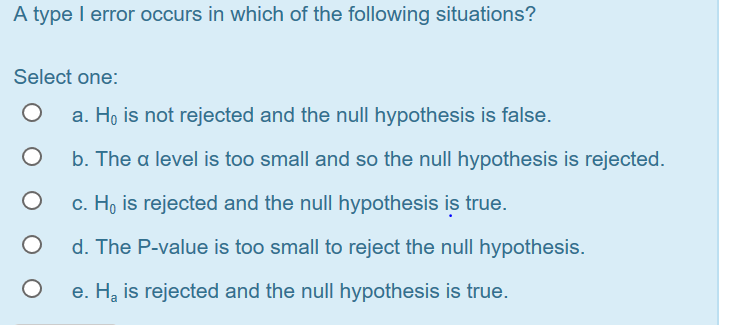
Solved A Type I Error Occurs In Which Of The Following Chegg Com
In other words it falsely infers the existence of a phenomenon that does not exist.
. Thus correct answer is. The patient does not have the disease. The soil is actually unsafe and the sample result is less than 400 ppm so construction continues.
CREF SpecializationCommercial Real Estate Finance. 0 D Neither of these. Rejecting the null hypothesis when it is in fact true is called a Type I error.
Tap card to see definition. Rejecting the null hypothesis when the null hypothesis is true. A type I error appears when the null hypothesis H 0 of an experiment is true but still it is rejected.
The null is false and we reject it. Type 1 and type II errors are mistakes in testing a hypothesis. The broker fails to reject the hypothesis that the mean price is 243765 when the true.
Click card to see definition. The probability of a Type I error 003 is smaller than α 005 and therefore the results are nonsignificant. The obtained z falls in the extreme 3 of the sampling distribution and the probability of a Type I error is 003.
The proportion of people who write with their left hand is equal to 029. FMVAFinancial Modeling Valuation Analyst CBCACommercial Banking Credit Analyst CMSACapital Markets Securities Analyst BIDABusiness Intelligence Data Analyst Specializations. Start studying Type I and Type II Errors.
B Which of the following is a Type I error. For this both knowledge of the subject derived from extensive review of the literature. Fail to reject accept the null hypothesis when the null hypothesis is false.
To test a claim about a mean when the population standard deviation is unknown we use. Question 1 Type I error occurs when we reject the null hypothesis in fact it is true. The null is true but we fail to reject it.
Which of the following is a Type I error in this context. Experts are tested by Chegg as specialists in their subject area. μ400 ppm soil is unsafe.
Hypothesis testing is an important activity of empirical research and evidence-based medicine. Which of the following best describes a Type I error. It means concluding that results are statistically significant when in reality they came about purely by chance or because of unrelated factors.
A type I error occurs when the results of research show that a difference exists but in truth. Learn vocabulary terms and more with flashcards games and other study tools. Here are the hypotheses for this test.
Type I error. 0 C Both of these are Type I errors. 15 Questions Show answers.
This is a correct decision. Type I Error. The patient does have the disease O A A healthy person receives treatment.
Cant find the question you are looking for. Click the button below to ask an Academic Professional. μ400 ppm soil is safe and H1.
The null hypothesis is actuall. Note that the type I error does not imply that we erroneously accept the alternative hypothesis of an experiment. O B A sick person does not receive treatment.
The obtained z falls in the extreme 3 of the sampling distribution and the probability of a Type II error is 003. A well worked up hypothesis is half the answer to the research question. Identify the type I error and the type II error that corresponds to the given hypothesis.
Reject the claim that the proportion of people who write with their left hand is 029 when the proportion is actually different from 029. They are both Type II errors. The type I error is also known as the false positive error.
Many people decide before doing a hypothesis test on a maximum p-value for which they will reject the null hypothesis. This value is often denoted α alpha and is also called the significance level. Which of the following would be a Type I error in this setting.
We review their content and use your feedback to keep the quality high. Which of the following is a type I error. A type I error is often called a false positive an event that shows that a given condition is present when it is absent.
Type I errors in statistics occur when statisticians incorrectly reject the null hypothesis or statement of no effect when the null hypothesis is true while Type II errors occur when statisticians fail to reject the null hypothesis and the alternative hypothesis or the statement for which the test is being conducted to provide evidence in support of is true. A Type I error means rejecting the null hypothesis when its actually true. The risk of committing this error is the significance level alpha or α you choose.
Now the hypotheses are. The null is true but we mistakenly reject it. When a research study obtains statistically significant findings that even when a research study obtains statistically.
It is stating something which is not present or a false hit. The broker rejects the hypothesis that the mean price is 243765 when it is the true mean cost OB. The null is false but we fail to reject it.
A type I error occurs if you reject the null hypothesis when it is true. Which significence level is more likely to see a type II error 005 or 001 001 this is because our results need to show an increadible relationship between IV and DV to reach 1 significence.
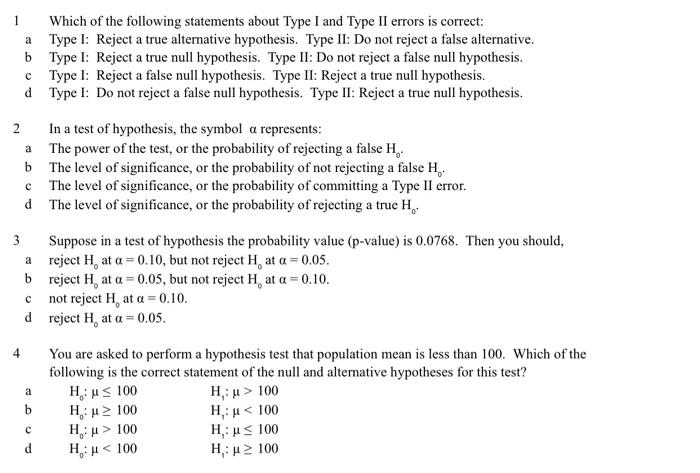
Solved A Which Of The Following Statements About Type I And Chegg Com

Solved Which Of The Following Best Describes A Type I Error Chegg Com
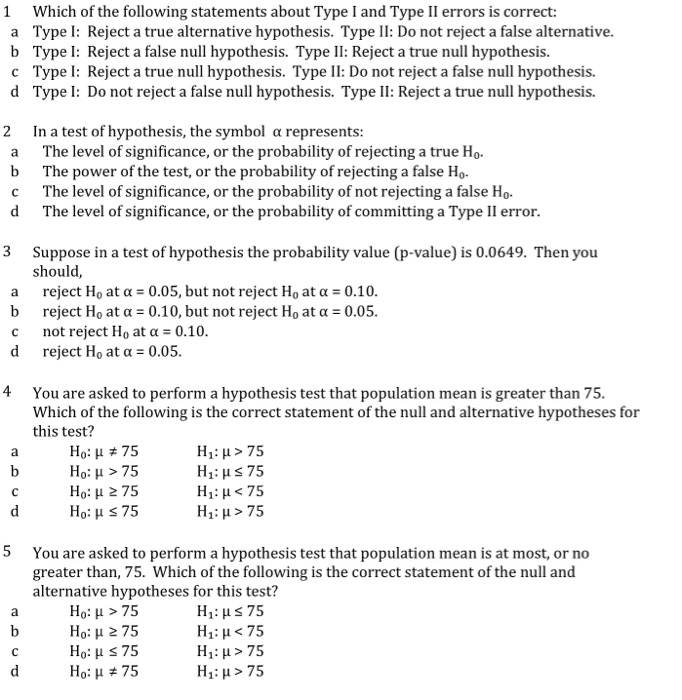
Solved 1 Which Of The Following Statements About Type I And Chegg Com


Comments
Post a Comment